AI Governance Lessons from History
How governance frameworks have transformed technologies from sources of harm to beneficial tools—and what this means for artificial intelligence
By Reza Olfati-Saber: Founder, CEO, and Chief AI Architect of Wisdom Agent Inc.
Understanding Technology Transformation
In my three decades working with AI systems—from research labs to enterprise implementations—I’ve observed a consistent pattern. Technologies that initially cause significant harm often become beneficial tools through the implementation of governance frameworks.
This observation led me to examine how other transformative technologies evolved from harmful to beneficial applications. The patterns that emerged offer profound insights for AI governance and reveal a universal truth: governance is the primary differentiator between technological good and evil.
The Historical Pattern: A Universal Law of Technology
Most transformative technologies follow a predictable progression that transcends industries, time periods, and cultural contexts:
- Initial deployment without governance → significant harm occurs
- Crisis recognition → society demands change
- Governance implementation → standards and regulations develop
- Transformation → technology becomes beneficial
This pattern appears across multiple technological domains with remarkable consistency, suggesting fundamental principles about how societies can harness powerful technologies for human benefit.
Medicine: From Death-Hastening to Life-Saving
The transformation of medicine represents perhaps the most dramatic example of governance-driven technological transformation in human history. For millennia, medical practice often hastened death rather than prevented it.
The Era of Medical Harm
Before professional standards emerged, medical technologies were deployed with devastating consequences. Mercury treatments for syphilis caused severe neurological damage and death, yet remained standard practice for centuries. Bloodletting and purging, considered sophisticated medical interventions, systematically weakened patients and often hastened their demise. Patent medicines containing cocaine, opium, and other dangerous substances were marketed as cure-alls, creating widespread addiction and poisoning.
Perhaps most telling was the state of surgery, where operations were performed without understanding of infection control, leading to mortality rates that often exceeded 50%. The medical profession of this era embodied the principle that good intentions without proper governance could produce catastrophically harmful outcomes.
The Governance Revolution
The transformation began with the establishment of the Hippocratic tradition, which introduced the revolutionary principle of “first, do no harm.” This ethical foundation was gradually formalized through professional licensing and certification systems, peer review and accountability mechanisms, ethical research standards following the Nuremberg Code and Declaration of Helsinki, and evidence-based practice requirements that demanded proof of efficacy before treatment adoption.
The Transformed Outcome
The result was extraordinary. Life expectancy doubled in countries that adopted rigorous medical ethics and professional standards. The same chemical knowledge that had poisoned patients with mercury now produces precisely targeted pharmaceuticals. Surgical techniques evolved from deadly procedures to life-saving interventions with success rates exceeding 95% for many common operations.
This transformation demonstrates that governance doesn’t constrain beneficial innovation—it channels technological capability toward human welfare while preventing harmful applications.
Nuclear Technology: From Ultimate Weapon to Healing Force
Nuclear technology presents perhaps the starkest example of governance determining technological outcomes. The same scientific principles that enabled the most destructive weapons in human history also power life-saving medical treatments and clean energy generation.
The Era of Nuclear Terror
Nuclear technology’s introduction to the world was through unprecedented destruction. The atomic bombings of Hiroshima and Nagasaki killed over 200,000 people and demonstrated technology’s capacity for civilizational threat. Atmospheric nuclear testing exposed entire populations to radioactive fallout without their knowledge or consent, causing cancer and genetic damage across generations.
Even civilian applications initially proved harmful. Consumer products containing radium—from toothpaste to watch dials—caused cancer and death among both workers and consumers. The “Radium Girls” who painted luminous watch dials suffered horrific deaths from radiation poisoning, yet their employers suppressed evidence of the health risks for decades.
The Governance Framework That Changed Everything
The transformation required unprecedented international cooperation and governance innovation. The International Atomic Energy Agency (IAEA), established in 1957, provided global oversight. The Nuclear Non-Proliferation Treaty separated civilian and military applications. Rigorous safety protocols made nuclear power one of the safest forms of energy generation, while international knowledge sharing for peaceful applications was balanced with restrictions on weapons development.
From Destruction to Healing
Today, nuclear medicine saves millions of lives annually through diagnostic imaging and cancer treatment. Nuclear power provides clean energy with lower casualty rates per unit of energy than any fossil fuel alternative. The same scientific principles that created weapons of mass destruction now power medical equipment that extends human life and provides clean energy for sustainable development.
Aviation: From Death Trap to Safest Transport
Aviation’s journey from one of the most dangerous human activities to statistically the safest form of transportation represents a triumph of governance-driven safety innovation.
When Flying Meant Dying
Early aviation was characterized by horrific casualty rates that would be unthinkable today. Aircraft were built without standardized safety requirements, leading to frequent structural failures mid-flight. Pilot training was haphazard, with inexperienced operators controlling aircraft they barely understood. Weather navigation was primitive, forcing pilots to fly blind through storms and fog, causing numerous crashes.
The Safety Revolution Through Governance
Aviation’s transformation began with the 1944 Chicago Convention, which established international safety standards and created the framework for global aviation governance. The governance revolution included standardized aircraft certification requiring extensive testing and documentation, professional pilot training and licensing with ongoing competency requirements, blame-free accident investigation that prioritized learning over punishment, and a continuous safety improvement culture that treated every incident as a learning opportunity.
The Statistical Miracle
The result was a 100-fold improvement in aviation safety over 50 years, making flying statistically safer than driving to the airport. In 2022, commercial aviation achieved zero fatal accidents among 32.2 million flights worldwide. This safety record represents one of humanity’s greatest achievements in making complex technological systems safe through appropriate governance.
Aviation demonstrates that governance frameworks can create demanding safety standards that drive breakthrough innovations rather than stifling them.
Automotive: From Pollution Machine to Clean Transport
The automotive industry’s evolution from environmental menace and safety hazard to increasingly clean and safe transportation demonstrates how governance can transform entire technological paradigms.
The Era of Automotive Carnage
Early automobiles were death traps that killed occupants and polluted the environment with impunity. Vehicles had no safety features—no seat belts, airbags, or crumple zones—leading to horrific fatality rates in accidents. Automotive emissions were uncontrolled, contributing to smog crises that made cities barely habitable.
Leaded gasoline caused widespread neurological damage, particularly affecting children’s cognitive development. Vehicle designs prioritized style over safety, with sharp dashboards and non-collapsible steering columns that impaled drivers in crashes.
Governance-Driven Transformation
The automotive revolution began with Ralph Nader’s “Unsafe at Any Speed” and was formalized through comprehensive safety and environmental legislation. The National Traffic and Motor Vehicle Safety Act mandated safety features. Clean Air Act emission standards required “impossible” pollution reductions. Fuel economy standards drove efficiency improvements, while international safety harmonization spread innovations globally.
The Clean Revolution
The result was a 90% reduction in emissions while dramatically improving safety and performance. Modern vehicles emit so little pollution that their exhaust is often cleaner than the air they intake in polluted cities. Safety features have reduced fatality rates by over 75% despite dramatic increases in vehicle miles traveled.
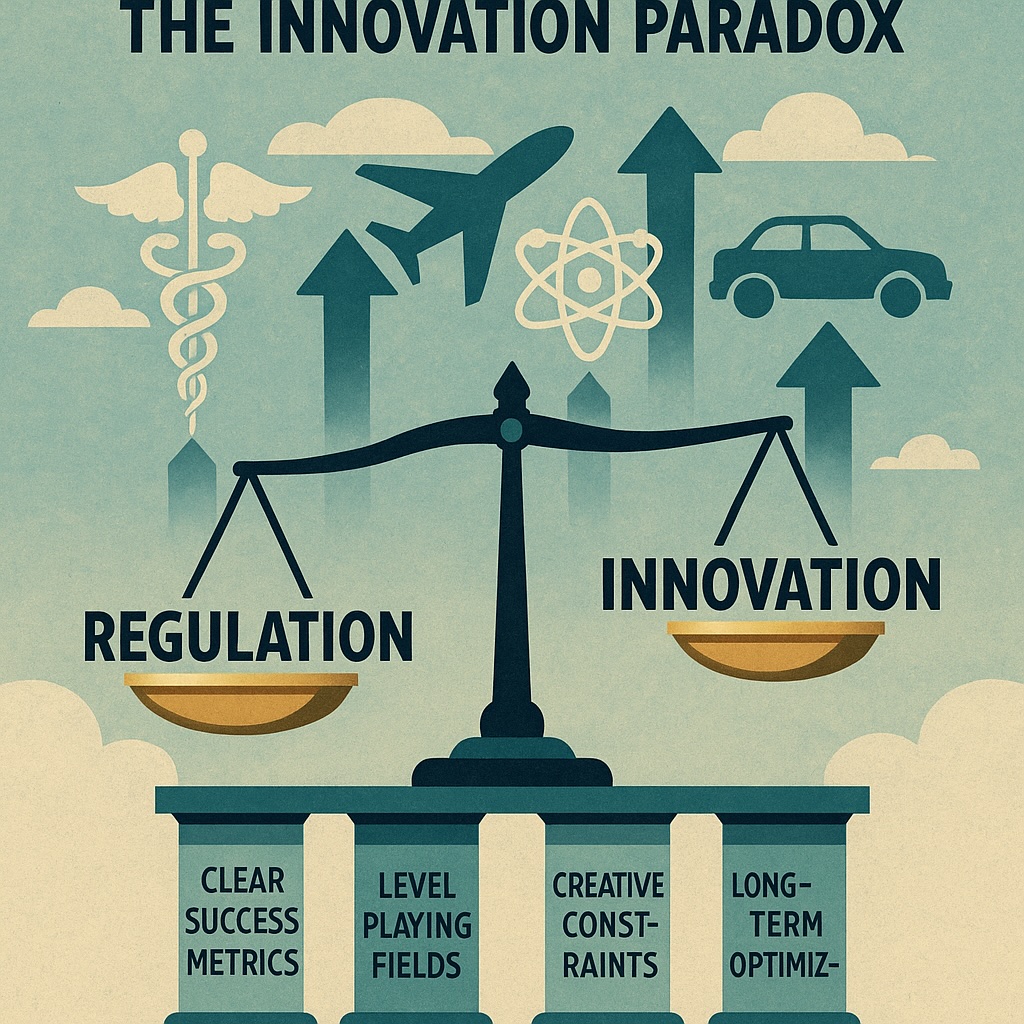
The Innovation Paradox: How Regulation Accelerates Progress
Perhaps the most counterintuitive finding from historical analysis is that heavily regulated industries often innovate faster and more beneficially than lightly regulated ones. This finding challenges conventional wisdom about regulation stifling technological progress.
Evidence for the Paradox
Aviation achieved a 100-fold safety improvement in 50 years under heavy regulatory frameworks, making it the safest transportation mode. The pharmaceutical industry developed dramatically more effective treatments with rigorous oversight than without it. Nuclear power became the safest energy source per unit generated under extreme regulatory scrutiny.
In contrast, lightly regulated industries often struggle with persistent problems. Software security issues continue despite decades of development. Social media platforms create mental health crises that persist years after recognition.
Mechanisms Behind the Paradox
The counterintuitive relationship between regulation and innovation operates through several mechanisms:
Clear success metrics emerge when regulations define what constitutes beneficial innovation, focusing research and development on socially valuable problems rather than arbitrary technical achievements. Level playing fields ensure that all competitors face the same constraints, preventing races to the bottom where harmful shortcuts provide competitive advantage.
Creative constraints force breakthrough innovations when requirements appear challenging with existing technology. Automotive emission standards that seemed impossible to achieve drove development of catalytic converters and fuel injection systems. Long-term optimization prevents short-term harmful practices that provide immediate benefit but create long-term costs and liabilities.
Elements of Effective Technology Governance
Analysis of successful governance frameworks reveals five universal elements that characterize effective technology governance across all examined domains:
1. Professional Standards and Ethics
Every successfully governed technology developed professional standards that made ethical behavior part of professional identity. Medical professionals operate under the Hippocratic Oath, engineers follow professional ethics codes that prioritize public safety, and aviation professionals maintain certification standards that prioritize safety over convenience.
Notably absent in artificial intelligence is any equivalent professional standard. AI developers currently operate without licensing requirements, ethical obligations, or professional liability for harmful outcomes.
2. Anticipatory Rather Than Reactive Frameworks
Successful governance anticipates problems before they become crises. The Asilomar Conference established biotechnology safety guidelines before disasters occurred. Aviation safety standards developed alongside technological advancement rather than in response to crashes.
In contrast, social media was deployed to billions of users before considering psychological impacts, creating mental health crises that we’re still struggling to address.
3. International Coordination
Technologies with global impact require coordinated governance to prevent races to the bottom. The Nuclear Non-Proliferation Treaty prevents widespread weapons development, aviation safety standards are harmonized globally, and the Montreal Protocol successfully banned ozone-depleting chemicals worldwide.
AI currently lacks international cooperation on safety standards, creating regulatory arbitrage where development migrates to jurisdictions with the weakest oversight.
4. Transparency and Accountability
Effective governance requires transparency that enables accountability and continuous improvement. Aviation’s blame-free accident investigation enables systematic learning from failures. Medical peer review and adverse event reporting catch problems before they spread.
In contrast, algorithmic opacity in technology platforms prevents accountability and learning from harmful outcomes.
5. Economic Alignment
Successful governance aligns profit incentives with societal benefit, making ethical behavior more profitable than harmful alternatives. Environmental regulations drove innovations in cleaner technologies that proved more profitable than polluting alternatives. Safety requirements in automotive manufacturing reduced insurance costs and liability while improving market appeal.
Current AI incentive structures often reward engagement and addiction over user welfare, creating systematic misalignment between profit and human flourishing.
The Timing Imperative: When Governance Matters
Historical analysis reveals that the timing of governance implementation critically determines its effectiveness and the extent of harm that occurs before transformation begins. Three distinct timing patterns emerge with dramatically different outcomes:
Too Early: Premature restrictions can stifle beneficial innovation before technologies reach maturity, potentially leading to technology abandonment or suboptimal development paths.
Just Right: Proactive frameworks that guide development toward benefit while allowing innovation to flourish represent optimal timing. Biotechnology’s Asilomar Conference exemplifies this approach—establishing safety guidelines before widespread deployment enabled five decades of safe innovation.
Too Late: Reactive damage control after preventable tragedies allows entrenched harmful practices to become difficult to change. Asbestos remained widely used for decades after its carcinogenic properties were known, exposing millions to preventable cancer.
Current AI Development Patterns
Artificial intelligence development shows several characteristics that historically preceded the need for governance frameworks, following the same harmful trajectory observed in other technologies before governance implementation.
Business Model Misalignment
Current AI business models often prioritize user engagement optimization, data collection for advertising, rapid deployment for market advantage, and competitive opacity. These priorities fundamentally conflict with the needs of regulated industries, which typically require safety and compliance focus, decision transparency and auditability, systematic risk management, and consistent international standards.
This misalignment represents a critical barrier to beneficial AI governance. Big technology companies have built their business models around consumer engagement optimization, creating systematic incentives that conflict with governance principles required for regulated industries.
Current AI Governance Failures
Artificial intelligence currently violates every principle of successful technology governance identified in historical analysis:
Absence of Professional Standards: Unlike medicine, engineering, or aviation, AI development lacks professional licensing, ethical codes, or accountability mechanisms. Developers can create systems affecting millions of users without training in ethics, safety, or social responsibility.
Reactive Rather Than Anticipatory Frameworks: AI systems are being deployed globally without adequate testing for social impacts, psychological effects, or long-term consequences.
Fragmented International Approach: AI development proceeds without coordinated international safety standards, creating regulatory arbitrage where development migrates to jurisdictions with minimal oversight.
Algorithmic Opacity: Most AI systems operate as “black boxes” with decision-making processes hidden from users, regulators, and often even their creators.
Misaligned Economic Incentives: Current AI business models often reward engagement, addiction, and data extraction over user welfare.
Emerging Challenges
Several concerning patterns are emerging that mirror early phases of other technologies before governance:
Social media algorithms contribute to rising rates of depression, anxiety, and suicide among teenagers. Recommendation systems create filter bubbles and echo chambers that promote extremism and undermine democratic discourse. Automated decision systems perpetuate and amplify bias in hiring, lending, criminal justice, and healthcare. Surveillance systems enable authoritarian control and erosion of civil liberties.
Framework for AI Governance: Learning from History
Based on successful governance transformations in other technologies, a four-phase implementation framework emerges:
Phase 1: Emergency Stabilization
Immediate actions are needed to prevent ongoing harm while more comprehensive frameworks are developed:
- Industry moratorium on new AI features affecting vulnerable populations, particularly children and teenagers
- Emergency audit of existing AI systems with documented harmful effects
- Establishment of an AI Safety Board with enforcement authority over systems affecting more than one million users
- Mandatory transparency reports from major AI companies detailing algorithmic decision-making processes and outcomes
Phase 2: Foundation Building
Fundamental governance structures must be established to provide long-term oversight:
- Professional certification programs for AI developers working on systems with significant social impact
- International treaty negotiations for AI governance, following successful models like the Nuclear Non-Proliferation Treaty
- Technical standards for explainable and accountable AI systems that allow independent audit
- Liability framework establishing clear responsibility for AI-caused harm, ending current immunity protections
Phase 3: Implementation
Deep changes in professional culture and institutional structures are necessary for sustainable governance:
- Integration of AI ethics into computer science curricula at universities worldwide
- Professional associations with enforcement powers and ethical codes similar to medical and engineering professions
- Public participation platforms enabling democratic input into AI governance decisions
- Economic incentive restructuring to align AI development profits with measurable human welfare outcomes
Phase 4: Ongoing Adaptation
Governance systems must evolve continuously with technological capabilities:
- Adaptive regulatory frameworks that update automatically as AI capabilities advance
- Enhanced international cooperation mechanisms for emerging AI risks and benefits
- Increased public and private research investment in beneficial AI applications that serve human flourishing
- Comprehensive success metrics tracking human welfare outcomes rather than just technical performance
The key challenges to implementing this AI governance strategy are strong resistance from major technology companies to domestic or international regulation, and international government policies that are ideologically-driven and resist changes unless regulatory frameworks favor their beliefs. International cooperation and establishing regulatory agencies are ways to address technology and ideological resistance, though this represents a monumental challenge requiring cultural education and awareness.
Building Responsible AI Systems
At Wisdom Agent, we focus on developing AI systems that prioritize transparency and accountability based on historical governance lessons. Our MAGI platform provides explainable decision-making processes with complete audit trails. Our emotional AI work emphasizes privacy protection while understanding and detecting users’ emotional intelligence needs through multi-modal AI.
We work with healthcare organizations to develop FDA-compliant systems, help financial institutions meet regulatory requirements, and assist educational organizations in improving outcomes while protecting student privacy. This approach demonstrates that governance frameworks can accelerate rather than hinder beneficial innovation.
The Current Opportunity
AI has reached sufficient capability to significantly impact society, presenting an unprecedented opportunity to implement governance frameworks proactively rather than reactively. Historical evidence demonstrates that governance frameworks can transform potentially harmful technologies into beneficial tools, with the timing of implementation affecting both the harm prevented and the benefits realized.
The blueprint for beneficial technology governance exists, validated across multiple industries and historical periods. Every successful technology transformation provides consistent lessons: professional responsibility must take precedence over pure profit maximization, transparency and accountability must replace secrecy and opacity, international cooperation must overcome nationalistic competition, human flourishing must be prioritized over raw technological capability, and anticipatory frameworks must be implemented before reactive regulation becomes necessary.
Conclusion
History demonstrates that governance frameworks can redirect powerful technologies from harmful to beneficial applications. Every major technology eventually develops governance structures—the question is whether these emerge through proactive planning or reactive responses to crises.
The evidence is overwhelming and the historical patterns are clear: governance transforms the same technologies that can destroy us into the tools that elevate us to improved prosperity, health, safety, and capability. Technology governance represents humanity’s capacity to ensure that human ingenuity serves human flourishing rather than human destruction.
AI governance represents an opportunity to apply historical lessons to shape technology development in beneficial directions. The frameworks exist, the precedents are clear, and the choice of timing remains open. We stand at a critical juncture where we can choose proactive governance that channels AI toward solving climate change, curing diseases, expanding education, and reducing inequality, or continue the current trajectory toward a surveillance capitalism future.
The time for choice is now. The blueprint is proven. The outcome depends entirely on whether we have the wisdom and courage to apply the lessons of history to the technology that will shape our future.
Further Reading
For readers interested in exploring the theoretical foundations and case studies of technology governance in greater depth, the following selected references provide essential background:
Foundational Theory
- Winner, L. (1980). “Do artifacts have politics?” Daedalus 109(1): 121-136. A seminal work examining how technologies embody political values and social arrangements.
- Bijker, W.E., Hughes, T.P., & Pinch, T.J. (1987). The Social Construction of Technological Systems: New Directions in the Sociology and History of Technology. MIT Press. Essential reading on how society shapes technological development.
Historical Case Studies
- Carson, R. (1962). Silent Spring. Houghton Mifflin. The landmark book that launched the environmental movement and transformed chemical industry regulation.
- Benedick, R.E. (1991). Ozone Diplomacy: New Directions in Safeguarding the Planet. Harvard University Press. The definitive account of successful international environmental cooperation through the Montreal Protocol.
Technology Safety and Innovation
- Reason, J. (1997). Managing the Risks of Organizational Accidents. Ashgate Publishing. The authoritative work on safety culture and blame-free accident investigation in complex systems.
- Porter, M.E. & van der Linde, C. (1995). “Toward a new conception of the environment-competitiveness relationship.” Journal of Economic Perspectives 9(4): 97-118. Groundbreaking research demonstrating how environmental regulation drives innovation.
AI and Contemporary Technology Governance
- Russell, S. (2019). Human Compatible: Artificial Intelligence and the Problem of Control. Viking. Essential reading on AI safety and governance challenges from a leading AI researcher.
- Zuboff, S. (2019). The Age of Surveillance Capitalism: The Fight for a Human Future at the New Frontier of Power. PublicAffairs. Critical analysis of how big tech business models conflict with human welfare.
Professional Standards and Ethics
- Freidson, E. (1970). Profession of Medicine: A Study of the Sociology of Applied Knowledge. University of Chicago Press. Classic study of how professional standards and ethics transform occupational practice.
- Berg, P., Baltimore, D., Brenner, S., Roblin III, R.O., & Singer, M.F. (1975). “Summary statement of the Asilomar conference on recombinant DNA molecules.” Proceedings of the National Academy of Sciences 72(6): 1981-1984. The foundational document establishing proactive governance for biotechnology.
Dr. Reza Olfati-Saber is the Founder & Chief Scientist of Wisdom Agent, Inc. His 25+ years of research in multi-agent AI and distributed systems — cited more than 49,000 times in academic literature — provide the theoretical foundation for the firm’s work.